

Abate Hailu, African View
For many years, development in Ethiopia has been discussed through the language of projects, funding, and service delivery. These efforts have contributed significantly to improvements in many sectors, but one fundamental question continues to shape the future of development: who decides what communities need and who leads the solutions?
That question is at the heart of the growing movement for localisation.
Localisation is no longer a conversation limited to international development meetings. In Ethiopia, it has gained increasing attention and acceptance among government institutions, civil society organisations (CSOs), international NGOs, donors, and communities themselves. The growing recognition is based on a simple reality: development works better when the people most affected by challenges have a meaningful role in designing and implementing solutions.
This shift in thinking represents an important opportunity for Ethiopia. The adoption of the Civil Society Organisations Proclamation No. 1113/2019 created a new environment for civil society engagement and opened possibilities for stronger collaboration between the government and CSOs. At the same time, global discussions on locally led development have encouraged development partners to reconsider traditional approaches that often placed local organisations in the role of implementers rather than leaders.
The change in attitude is visible. Donors are increasingly interested in working directly with local organisations. International NGOs are exploring more equal partnerships with Ethiopian CSOs. Government institutions are recognising that civil society can contribute not only to service delivery but also to policy dialogue, innovation, accountability, and community engagement.
However, localisation should not become another development slogan. Its real meaning goes beyond transferring funds from international organisations to national organisations. Localisation is about shifting power, decision-making, and ownership closer to the communities where development takes place.
Research has consistently shown that participation matters. In Localising Development: Does Participation Work?, World Bank researchers Ghazala Mansuri and Vijayendra Rao examined evidence from community-based development initiatives worldwide and highlighted the importance of genuine community involvement. Their work shows that development interventions are more likely to achieve lasting results when communities are not simply consulted but actively involved in shaping decisions.
Ethiopia's civil society organisations have a unique advantage in this regard. Local organisations understand the languages, cultures, social structures, and realities of the communities they serve. They often have long-standing relationships of trust that cannot be created through short-term projects. During humanitarian crises, development challenges, and local emergencies, Ethiopian CSOs are frequently among the first actors responding to community needs.
This local knowledge is one of Ethiopia's greatest development assets. It should not be treated as secondary to technical expertise brought from outside. Instead, it should be recognised as a foundation for stronger partnerships.
The importance of local institutions and community leadership is also reflected in the work of Nobel Prize-winning economist Elinor Ostrom. In her influential book Governing the Commons, Ostrom demonstrated that communities can create effective systems to manage shared challenges when they have appropriate authority, trust, and institutional support. Her research provides a powerful lesson for development practice: communities are not simply recipients of solutions; they are capable leaders and problem-solvers.
In Ethiopia, this principle is increasingly reflected through the work of the Movement for Community-Led Development (MCLD) Ethiopia. Bringing together national and international civil society organisations, MCLD Ethiopia continues to promote the idea that communities should be at the centre of development decisions. Through advocacy, learning, collaboration, and evidence generation, its members are helping advance the understanding that development is strongest when communities lead.
The movement for community-led development has also generated important evidence through initiatives such as the Impact of Community-Led Development on Sustainable Development Outcomes (InCLuDE) research. Findings from this work demonstrate that when communities participate meaningfully in planning, implementation, and monitoring, development efforts are more likely to strengthen resilience, improve local governance, and create lasting social impact.
At the same time, localisation requires responsibility from Ethiopian CSOs. Greater leadership must come with stronger governance, transparency, accountability, and professional standards. Public confidence is built through integrity and results. Local organisations must continue investing in institutional capacity so they can take on greater responsibilities and demonstrate that localisation is not only desirable but achievable.
International partners also have an important role to play. Supporting localisation does not mean withdrawing international support. It means changing the nature of the partnership. Development partners should move away from relationships where local organisations simply implement externally designed programs and instead build partnerships based on shared decision-making, trust, and long-term investment in local institutions.
The government has a similarly important role. A strong civil society is not a competitor to government; it is a partner that can help identify community priorities, improve public engagement, and contribute innovative approaches to national challenges. Constructive cooperation between government and civil society can create stronger outcomes for citizens.
The success of localisation in Ethiopia should not be judged only by how much funding reaches local organisations. The deeper question is whether communities have greater influence over decisions affecting their lives, whether local institutions are becoming stronger, and whether development gains can continue beyond individual projects.
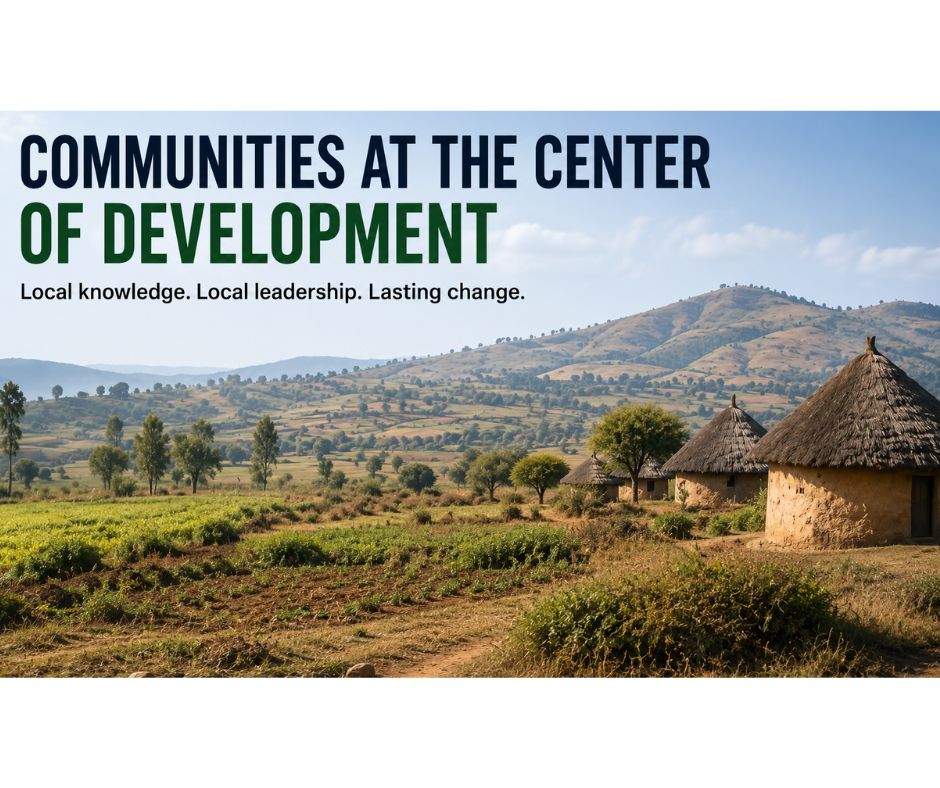
Ethiopia is at an important moment. The growing acceptance of localisation and the expanding movement for community-led development provide an opportunity to redefine how development is understood and practiced. The country does not lack community knowledge, local leadership, or committed organisations. What is needed is greater trust in these resources.
The future of development belongs to partnerships where communities are not viewed as beneficiaries waiting for solutions but as leaders capable of creating them. If Ethiopia can move from development done for communities to development led by communities, localization will become more than a policy commitment it will become a pathway toward a more resilient, accountable, and self-reliant future.
Comments