

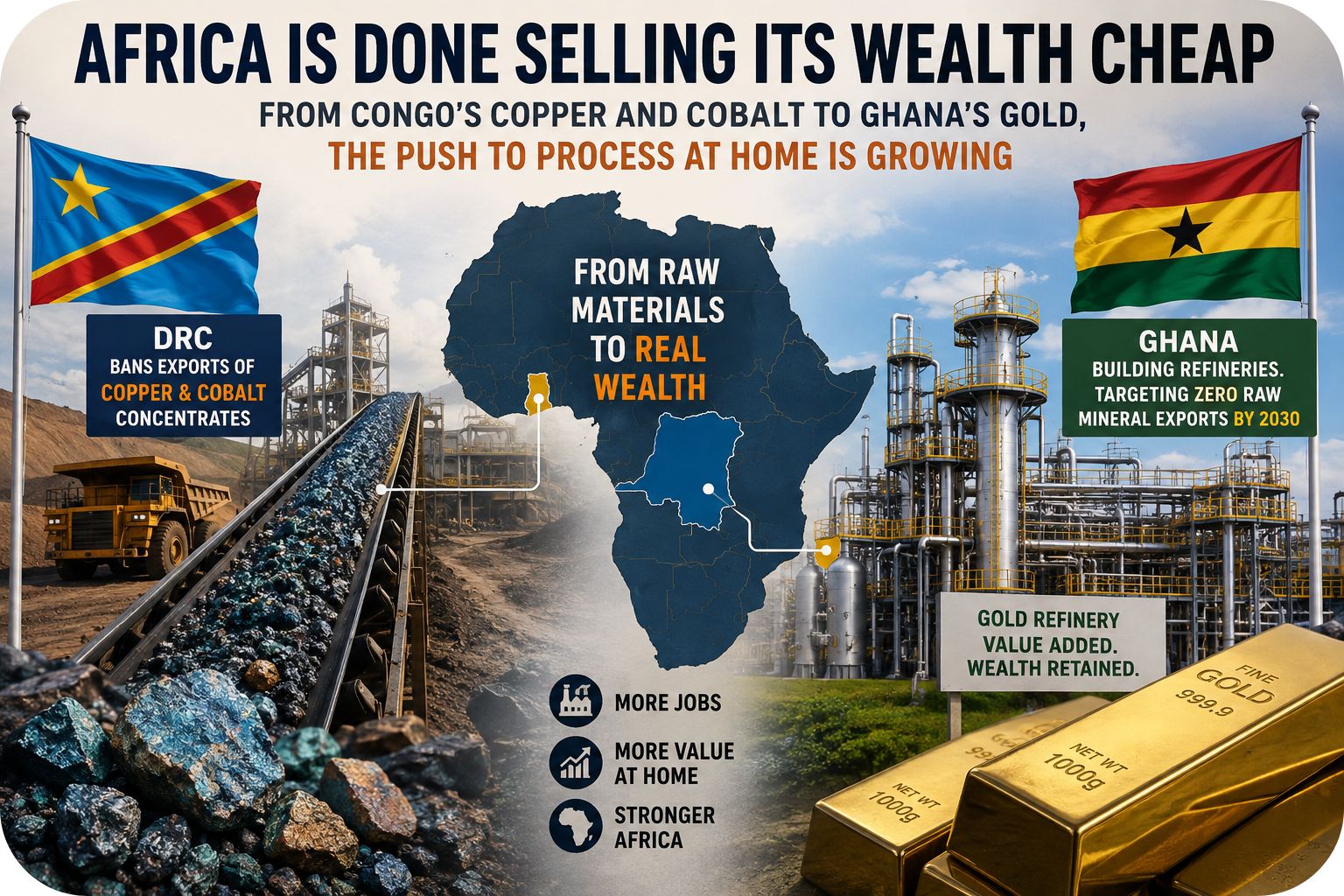
Africa Is Done Selling Its Wealth Cheap
By African View
For generations, Africa has extracted its wealth, shipped it overseas and watched other economies turn those raw materials into a pound for every penny they buy. This century-old model may finally be facing a serious challenge.
The Democratic Republic of Congo has banned exports of copper and cobalt concentrates, escalating its drive to process its minerals at home. The recent government order took effect immediately, although there are some exemptions.
This is not a ban on all raw-material exports. But it is a significant signal from a country that sits at the heart of the global supply chain for two critical minerals.
The DRC is the world's dominant cobalt producer and a major copper supplier. Resources are increasingly in demand for electric vehicles, batteries and the global energy transition. Kinshasa now wants more of the economic value generated by those minerals to remain inside the country.
The West African country, Ghana, is taking a different route to the same destination: local processing before export.
The Ghana Gold Board, or GoldBod, has begun supplying gold to domestic refineries. In February, it inspected the first batch of gold that was refined locally at Gold Coast Refinery, under an agreement providing up to one tonne of gold a week for processing.
In May, GoldBod signed a second agreement with Royal Ghana Gold Refinery, also to provide up to one tonne a week. Ghana says the objective is to retain refining fees and other economic benefits domestically, create employment and strengthen its position in the international gold value chain.
Starting from July 2026, large-scale mining companies agreed to sell 30% of their gold output to GoldBod. The government says the gold will be refined locally, with the broader objective of achieving international accreditation for at least one Ghanaian refinery by 2030. Ghana has also declared a goal of zero raw-mineral exports by 2030.
The Royal Gold Ghana refinery was formally inaugurated in July, adding physical refining capacity to that ambition.
A tonne of mineral ore leaving an African mine can eventually become batteries, electronics, jewellery, machinery or other high-value products somewhere else: creating jobs, technology and industrial capacity far from where the resource was extracted.
That is the economic leap African governments needed to take. But there is a catch.
Banning exports does not automatically create an industrial economy.
Local processing requires reliable electricity, transport networks, skilled workers, finance, technology, laboratories and access to large markets. Without those foundations, export restrictions can create new difficulties for miners and governments rather than the industrial transformation they seek.
The DRC itself is already confronting that challenge. Reuters reports that most of the country's copper and cobalt is already refined domestically, meaning the new restriction is aimed at pushing the remaining concentrate exports further toward higher-value processing.
Ghana, meanwhile, is betting that expanding refining capacity can turn its position as one of Africa's major gold producers into a stronger industrial advantage.
Africa is beginning to recognise that its enormous mineral reserves are not simply geological assets. They are bargaining power in a world racing for energy-transition minerals and strategic commodities.
The DRC controls resources the global battery industry desperately needs.
Ghana possesses gold that global financial markets cannot ignore.
The question is whether African countries can move beyond competing individually for investment and instead build regional value chains, where minerals are extracted, processed, manufactured and traded within Africa.
That would realise the essence of the African Continental Free Trade Area.
And become the beginning of a very different African economic narrative.
Comments